
According to the Singapore Post, Kiribati a Micronesian country is discussing opening up its largest marine reserves to commercial fishing which may serve a dual purpose like a naval base for the Chinese as well.

The agreement would divert China's attention and keep them busy in the Pacific theatre, probably resulting in a reduction in threat perception in our area of interest in the Indian Ocean, notes Commodore Venugopal Menon (retd).
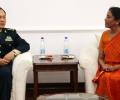
'In the case of an India-Pakistan confrontation, the Chinese may undertake more than just posturing, thereby constraining us from deploying adequate forces for decisive results,' warns Brigadier S K Chatterji (retd).

The ministry's year-end review is silent on the continued occupation by Chinese troops of territory that India has always claimed and patrolled.

Indian Armed forces will leave no stone unturned to safeguard the country's frontiers, he insisted.
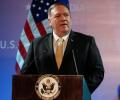
The United States, he said, 'desires a new age of ambition' in its relationship with India. Asserting that the US has never been more supportive of India's security, he said New Delhi too, is an important partner and a key pillar of President Trump's foreign policy.

'After a strategic pause though, Beijing will revive its policy of slowly creeping towards acquiring sovereignty over the South China Sea.'

16 Indian Army divisions face China, 20 face Pakistan and two divisions are reserves. This powerful signal can hardly be missed in China or Pakistan, notes Ajai Shukla.
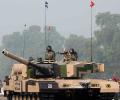
Senior Colonel Liu Degang said the Arjun tank is "very good" and suits Indian conditions.

'The US will not want to tangle with China landwards.' 'Nor will the US confront the Chinese navy seawards on India's account.'

China is engaged in hotly contested territorial disputes in the South and East China Seas. Beijing has also made substantial progress in militarising its man-made islands in the past few years, which it says it has the right to defend.

Admiral Philips Davidson, Commander of the US Indo-Pacific Command, also told the powerful Senate Armed Services Committee on Tuesday that China's recent activities along the Line of Actual Control have opened India's eyes to what cooperative effort with others might mean for their own defensive needs as he observed that New Delhi, in the very near term, will deepen its engagement with the Quad.
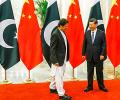
'If a 'two-front war' develops, Iron Brother may only turn out to be a drag on the PLA, since Pakistan is in no position to wage a war with India,' argues Ambassador M K Bhadrakumar.

The balloon, which was being used by the People's Republic of China in an attempt to surveil strategic sites in the continental United States, was brought down above US territorial waters.
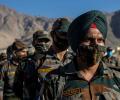
The political-electoral calculus favours spending thousands of crores on vanity projects like Sardar Patel's statue and the Central Vista over building up our military to handle the confrontations and conflicts that loom large, points out Ajai Shukla.
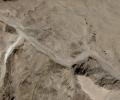
The Chinese probably thought that brutal assault was a knock-out, but they had not counted on the ingenuity, loyalty and courage of battle-trained Indian officers and jawans.

The PLA Air Force has conducted a combat air patrol in the South China Sea recently, which will become "a regular practice" in the future

Chinese military has identified a host of problems after conducting massive military exercises for the first time to sharpen the troops' fighting capability which if not rectified will hinder its ability to win wars.

Hydrography (underwater geography) prevents the Indian Navy for opting for an all-conventional, or all-nuclear submarine fleet.

China for the first time has divulged the deployment of a nuclear submarine for anti-piracy operations in the Gulf of Aden, a move defence experts say could cause unease among neighbours, including India.

The seventh Tibet Work Forum was held in Beijing on August 28 and 29. Delhi should be deeply concerned, at a time India faces a precarious situation in Ladakh, because the TWF also defines China's western border policies, observes Claude Arpi.
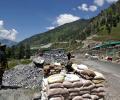
The meeting was attended by National Security Advisor Ajit Doval, Chief of Defence Staff General Bipin Rawat, Army Chief General M M Naravane, Navy Chief Admiral Karambir Singh and Indian Air Force Chief Air Chief Marshal R K S Bhadauria.

The elephant in the room will permeate the conversations, predicts Rup Narayan Das.

'With the recent challenging of the notion of the Indian Ocean Region being India's strategic backyard, China is gradually upping the ante in the maritime realm around India.'

Rediff.com tells you all you need to know of some of the major ships from different countries that will participate in what is being described as 'Indian Navy's biggest event'.
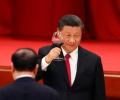
After the Ladakh fiasco where Xi Jinping did not expect the Indian Army to resist his land-grabbing tactics, he has to save face before his colleagues in the Communist party.' To bring the threat of a mega-dam to the northern Indian border is a clever move, observes Claude Arpi.
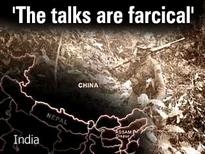
'The border disputes have a genuine problem because whatever Chinese are claiming and whatever they are ready to give both belong to India,' says China expert Srikant Kondapalli.

China's National Health Commission in its daily report on Monday said that 2,829 new cases of coronavirus were reported nationwide on February 2, taking the total number of infection to 17,205.
Xi ordered the military to think about worst-case scenarios, scale up training and battle preparedness, promptly and effectively deal with all sorts of complex situations and resolutely safeguard national sovereignty, security and development interests, state-run Xinhua news agency reported, without mentioning any specific issues that posed a threat to the country.

The Border Defence Cooperation Agreement with China needs closer scrutiny, says Rup Narayan Das.

However, Denmark said it is difficult to conclude on the real intention behind this.

'The military aim in a future conflict, if it can't be avoided, should be to cause maximum damage to the adversary's war waging capability and capture limited amount of territory as a bargaining counter,' says Brigadier Gurmeet Kanwal (retd).

Future, even present, wars -- at least those involving such tech giants as China -- include hi-tech battlefields, which a Pakistan-obsessed India has not sufficiently prioritised. Today's generals plan on how to disrupt an enemy city's power supplies, rail networks, airports, ports, and government departments, not just by bombing or torpedoing them; they also examine the option of tripping up the computer networks that run these, notes David Devadas.

India must break out of this strategic triangulation between China and Pakistan. We need to settle our issues with one of the two, notes Shekhar Gupta.

'Once positions are hardened and troops start building defences, it is difficult for soldiers to step back.'

'If you behave like a nail, the adversary will behave like a hammer.'

'We are facing the most critical military situation with China in the last 50 years.'

Besides being the President, 62-year-old Xi is already General Secretary of the ruling Communist Party and Chairman of the Central Military Commission.

'By causing military humiliation of India it intends to send a signal to other Asian countries to toe the Chinese line,' argues Colonel Anil A Athale (retd).

"CCP's (Chinese Communist Party) territorial aggression is also apparent on its Indian border where China has attempted to seize control of the Line of Actual Control by force," US National Security Advisor Robert O'Brien said in a remark on China early this week in Utah.
